🤳10 podcasts I texted my friends (cruise mystery, crocodile catching, predator catching)🍭 👂 I feel like I’m watching the end of world 🌈 🤸♀️
Bonjour. Today is Monday, October 5, 2026. There are 165 days until my next Disney Cruise. xoxo lauren 🚨the one thing🚨
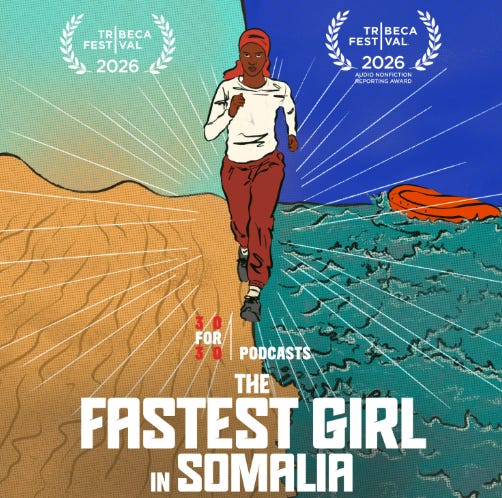
30 for 30 audio documentaries cannot be beat. The last two, gripping stories about the Shohei Ohtani betting scandal and the 2006 murder investigation of University of Miami defensive tackle Bryan Pata, got a lot of attention. They’re flashy, had groundbreaking original reporting and were topics already prominently in the news. But the one that just dropped, The Fastest Girl in Somalia, is the one that has stolen my heart and is exactly the kind of thing I dream of hearing. It tells the story of Somali runner Samia Yusuf Omar, who drowned in April 2012 on an overcrowded migrant boat while trying to make it to the Olympics. Host Teresa Krug got to know Samia years ago, kept in touch with her as she dangerously set out for a better life, a life that could get her to there, up until the day she died, which Teresa found out about quite late. (Hardly anyone knew. Samia’s death was an unceremonious one.) It’s hard to imagine what Samia went through or the risks she knew or did not know she was taking, but it is easy to imagine how if you have nothing at all you have nothing to lose. Samia likely died by being pulled underwater when one of her boatmates was drowning. That’s what people do when they are drowning, they grasp for whatever they can hold on to. And that’s what Samia was doing her whole life, trying to pull onto anything that she could to get to a better life. Samia didn’t get the life or death she deserved but The Fastest Girl in Somalia is the best tribute you could hope for. It is meticulously made, poignant, haunting, dangerous, and important. The storytelling is chef’s kiss. I kept wondering how on earth the team would tie up this story and it ends so beautifully, with an image of Samia running ahead of Teresa, laughing, not wanting to slow down to let Teresa keep up. I know it will stick with me for a very long time and I hope it finds the audience who needs to hear it. ~sponsored~
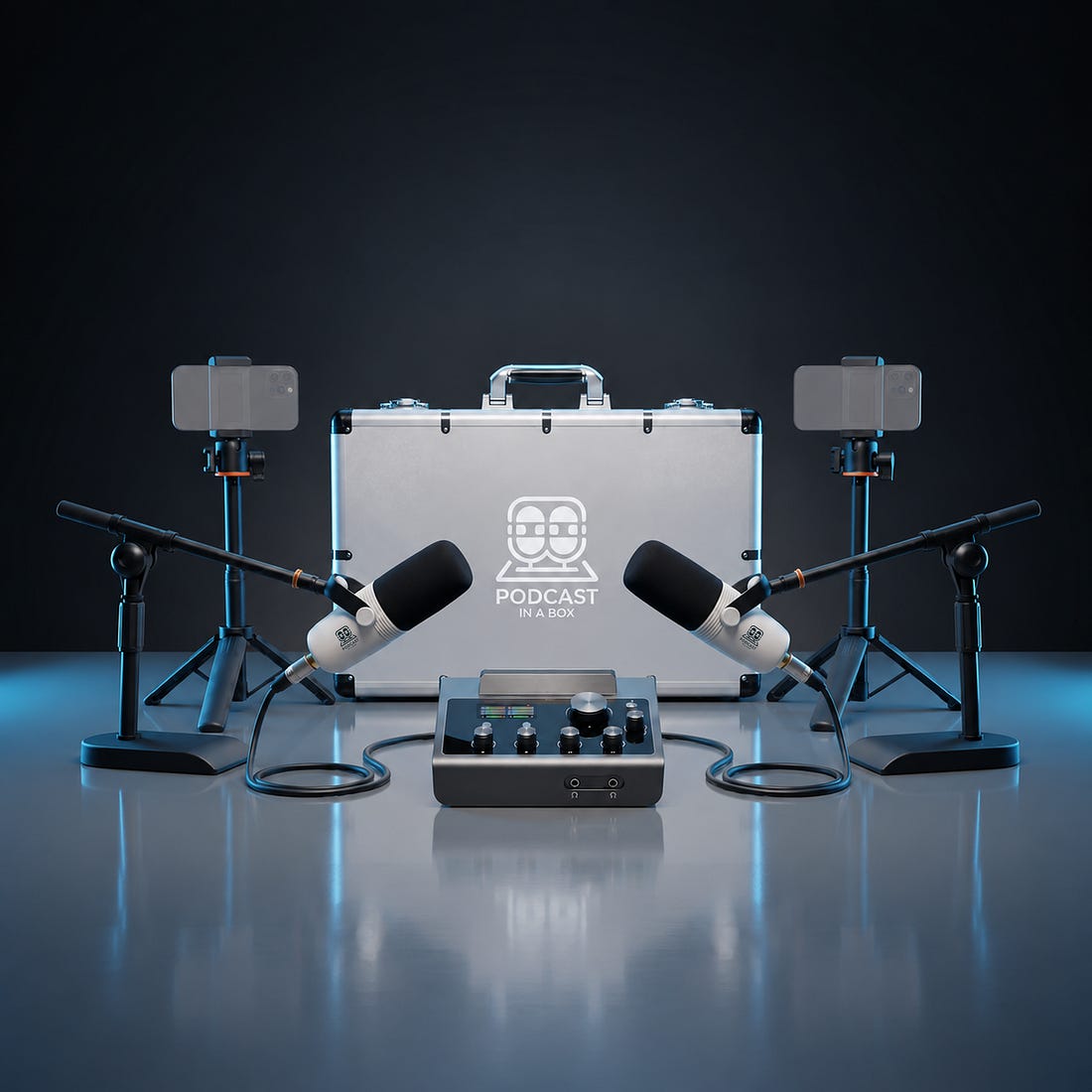
Podcasting shouldn’t require a studio full of gear. Podcast in a Box gives creators a complete portable multi-camera podcast setup built around the phones they already own—professional microphones, audio interface, stands, case, and streamlined recording app. We’re live on Kickstarter now. Back the campaign and build your studio anywhere. notes📌The International Women’s Podcast Awards take place THURSDAY. Get tickets here, see the SHORTLIST here.📌Yesterday, Arielle Nissenblatt🎧 featured 5 Podcasts About the Resources We’re Flushing Away in EarBuds. 📌The Nigerian Podcast Index released its 2026 Industry Report, documenting 604 Nigerian and Nigerian-diaspora podcasts — an 83% increase from the 329 shows recorded in 2025. Released on International Podcast Day, the report offers the most comprehensive year-on-year analysis of Africa’s largest English-language podcast ecosystem. Read the report here. 📌Read about Will Coley’s custom wedding podcast company Listen With Us in the New York Times. How he does it, why it works. I wish Will had come to my wedding. 📌Galicia Podcast Summit returns to A Coruña, Spain, on October 14 for its fifth edition. This year’s event, themed “Podcasting After Audio,” brings together six podcasting professionals and independent creators to explore how the format is evolving, the different ways of building a podcast, and what happens when a podcast eventually stops recording. The free, in-person event will feature two conversation panels and dedicated networking sessions, bringing together podcasters and industry professionals for a day of conversations, ideas and connections. 💎podcasts i texted to friends💎
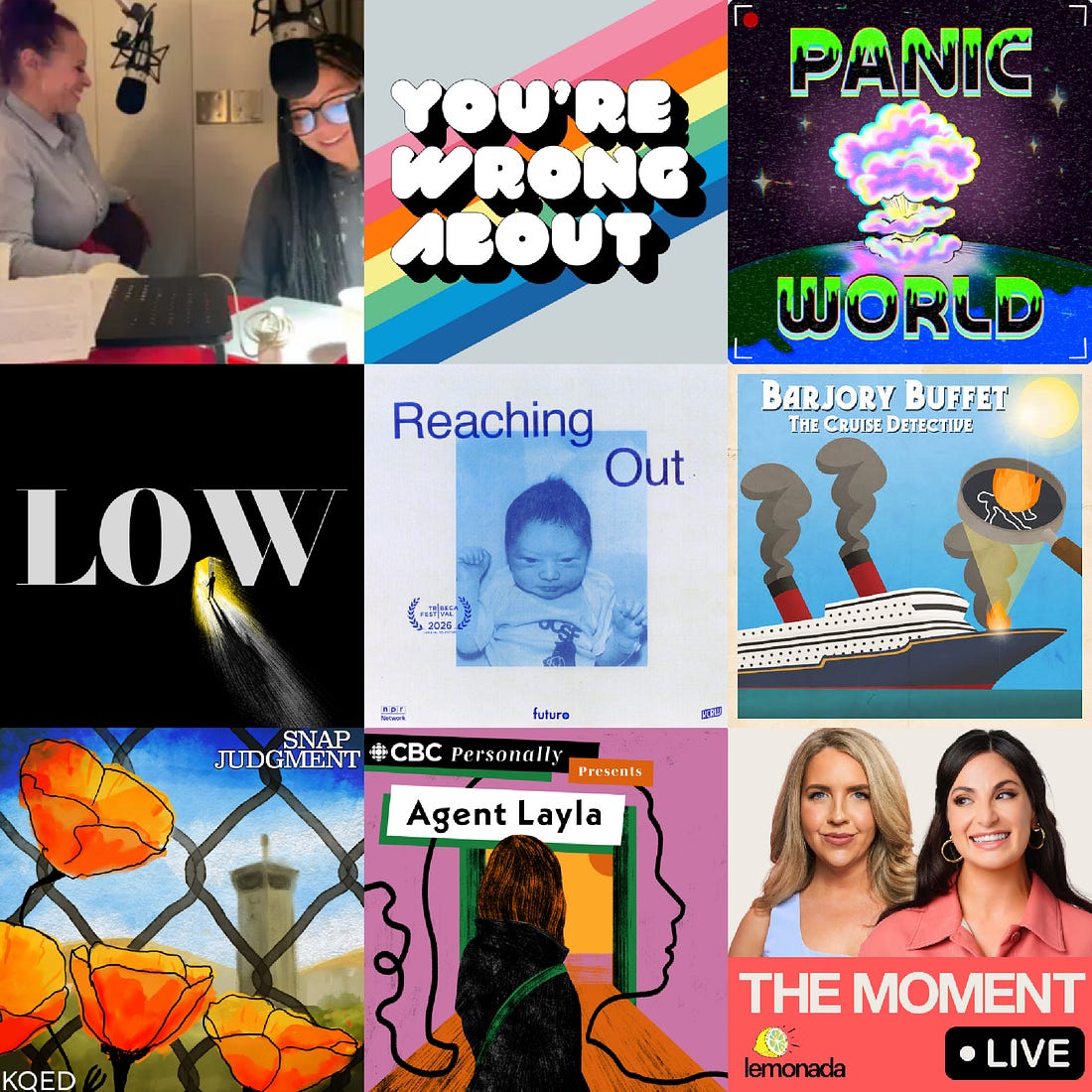
✨There are lots of tense moments happening in Personally: Agent Layla, CBC’s four-part series about a woman who becomes the undercover agent in her own sexual assault investigation. It’s a tense story…at 20, Vienna Luke was drugged by her brother-in-law Justin, this churchy guy everyone loved, who then violated her when she passed out so he could take disgusting photos of her. Vienna spent years trying to fill the gaps of her memory and move on. Eventually, with the help of her sister and authorities, she eventually faces Justin in a secretly recorded conversation where he admits it all. I was on pins and needles during the audio we get to hear. It feels like something we should not be listening in on, and the things Justin admits are shocking. But the best part is hearing Vienna, who started out in this story pretty insecure, a sheltered person who didn’t love herself, masterfully demand answers and patiently push past Justin’s evasions until he confesses. So along with the tenseness, there is real celebration. I was cheering for this victory, for this cartoonishly evil slimebag to get caught, for Vienna’s badass sister who seems to have been BORN to hunt down her sister’s sexual assaulter, and for Vienna, who we see clearly in 4 pretty short episodes transform into a super hero. She kept diaries through it and it’s really moving to hear her read from and react to them. This is not about the mechanics of a sting, it’s about the damage of being disbelieved, the complicated loyalties of family, and what it means to reclaim your story. This isn’t just well-made audio, I am positive that it will inspire people to come out with their own stories. Start with “The Sin That So Easily Entangles” here. How I discovered it: This is one of the best feeds I subscribe to, so I would have listened to matter what. But I did get an email with the entire CBC fall catalogue and it reminded me of being 7 and getting the Macy’s Christmas catalogue in the mail right before the holidays. ✨When I was judging Tribeca I had the pleasure of hearing a very early listen of Reaching Out, a documentary from Futuro Media about twin brothers Sayre and Connor, who are searching for their biological father. (It won.) It is the style of this show that stopped me in my tracks. It’s stripped down and doesn’t feel flashy on the surface, but underneath, there is a ton happening. I saw someone on Reddit complaining about the fact that the narrator, Sayre, uses second person. That’s something I loved. (It reminded me of another show I loved, The Idiot, but this is much better. Much more human and complex.) Throughout, it’s funny, textured, moving, honest, and unlike other things I’ve heard. Sayre is lonely in his NYC apartment (god do we feel like we are locked in that apartment with him, I felt lonely listening to it) talking to his brother on the phone frequently, who he argues with and loves deeply (Sayre points out that he believes his brother is a judgmental hobo and that Connor probably thinks he is a judgmental normie) and also his mom, who sounds like the kind of person I want to go get drinks with. The biological father is Sayre’s way into a story about connection. He is trying to make sense of this man’s life that he had no part in. You’re set to make sense of your own parents, siblings, and selves. At one point Sayre tells a story from Mormanism (his biological father is Morman) about a document called the Salamander Letter, which claimed that Joseph Smith was basically led to the Book of Mormon by a salamander and not an angel, which goes against the Mormon church. He asks: what’s the difference between a salamander and an angel if both get you to the end of the story? What’s the difference between myth vs forgery in our own stories if they get us to our end? Sayre has this way of pulling it all together beautifully, almost everything he documents in his life seems to point to this theme of reaching out and showing up when someone else does. Or does not. This show does not have a Hallmark movie ending. I not only wrote this down but scrubbed back so I could listen to Sayre say it several times: “Not showing up is the kindest way we can hurt each other.” Listen to Reaching Out here. How I discovered it: Tribeca for the first few episodes then I was very annoying about getting advance audio for the rest ✨Ali Prout was sexually assaulted by an officer as an inmate at Central California Women’s Facility (not that it matters but she was there for a non-violent crime in the first place) and Snap Judgment tells the story in a 3-part series. Because of the name of the series, “We Are Jane Doe,” I assumed it was going to be a story about Ali fighting back and bringing the officer down, and it is. But that’s not all it’s about. Ali did speak up about her assault, and it exposed a huge pattern of other cases at the prison, prompting an investigation that nailed the same officer for assaulting at least 20 other women. But it gets worse. After Ali spoke out, more than 150 of her fellow inmates were herded into a chow hall while guards searched their cells, which led to a violent confrontation involving pepper spray (one of the inmates is now legally blind from the incident) and physical force. This was their punishment for speaking out. Listening to the details of the raid, I could not believe how brazen these officers were, how horrifying and shocking it all was. Imagine what’s happening in secret! I mean, thanks to Ali and the other women who spoke up about their attackers, we’re finding out. But most of these women are saying they would not speak out again. Would you? Anna Sussman and Madi Bolanos spent two years investigating this story, talking to these women, getting their hands on leaked audio and surveillance footage, and going through internal prison documents to reconstruct what happened the day of the raid. It’s a powerful trilogy of episodes that points out this decision all women have to make about being brave enough to say something, women in prison in particular. Prisons are taxpayer-funded institutions but most of the time we don’t know what’s going on in there. They can be black boxes. We get inside this black box. Don’t miss the bonus stuff with Anna and Madi at the end, it’s cool to hear about what it takes to get a story like this made. Snap Judgment puts out so much good stuff so consistently you could easily forget to check in, but don’t. Start “We Are Jane Doe” here. How I discovered it: Subscriber but I got an email from Anna ✨Someone, let’s call him Zachariah (because that is the pseudonym we get) reached out to Jack Rhysider years ago for a specific story for Darknet Diaries. Zach’s life was so crazy that Jack got him on the phone and didn’t hang up for a very long time, not until Zach stopped answering. Not until Zach went missing. Zach’s life, it turns out, is crazier than any adventure story you’ve heard. At age seven, he nearly beat another kid to death. As a teenager, he became addicted to meth so severely that his friends had to strap him to a bed. Later, he became a teenage vigilante hunting pedophiles on the dark web. For Jack’s new limited series LOW, we get to hear Jack’s conversations over the years with Zach. Every story is more unbelievable than the next, you really don’t know what to believe, if any of it, but it doesn’t really matter to me. I have spent too much time thinking about which anecdotes are true, exaggerated, totally made up, or if this person is just fucking with Jack. In the end, Jack asks us to not respond immediately, which is what I am doing now. He wants us to sit with this for awhile. Zach’s life story might make you think about your own. This was an intense meditation on that reminded me of two things: Beautiful / Anonymous (Jack is along for the ride not doing a “gotcha” interview at all, but more a “I want to figure out what makes you tick”) and also Blindboy, because it was meditative and thoughtful. Jack isn’t just like “bro, this shit is crazy,” he pulls in philosophy to try to make sense of Zach’s life, that might be over or never real to begin with, and his own. Listen to LOW here. How I discovered it: I think Jack mentioned it on the Darknet Diaries feed ✨Sometimes I notice themes in episodes I am covering for an issue of Podcast the Newsletter. Last week was super sad, this one feels super icky and dark. We have lots of sexual assault, injustice, and death. I don’t often curate too heavily what I feature in Podcast the Newsletter, it’s usually a reflection of whatever I listen to. This week, there was another sexual assault series that I listened to that I decided to hold for another week because Jesus, enough. (Primetime, the thriller about To Catch a Predator, is driving this, as is the Cornell Chi Phi assault case. So, happy Spooky Season, I guess.) Anyway Panic World had an episode about why To Catch A Predator videos feel so gross and the conversation felt completely terrible and honestly exhausting but also important. It helped that as always, Panic World ends up being funny without being flippant about sensitive stuff. Ryan, Gavin, and Free Country USA’s Jeff and Kitty Kimz talk about why online vigilantism about sexual criminals, a kind of content that has exploded since To Catch A Predator ended (after only 20 episodes because someone committed suicide during a segment,) feels so much more disgusting and exploitative than what Chris Hansen was doing on the TV show. Maybe it shouldn’t. The aesthetics of these videos are gross. (Ryan calls it “very rightwing/fascist/Robocop.” I realize victims of sexual assault might find them cathartic, but it still disturbs me to think about some of the people high-fiving and hell-yeahing this stuff. Ultimately, this is a conversation about how “catching predators” can make things worse, not better, and how often vulnerable people get swept up in these things instead of people in power who are much better at being pedophiles. Listen to “Why “To Catch A Predator” videos feel so gross” here. How I discovered it: Subscriber ✨I listened to Panic World when it came out on a Wednesday and You’re Wrong About when it came out the day before. I wish I had listened the other way around, and that’s my recommendation to you, because Sarah’s episode with Brianna Bowman about Steve Irwin was the balm you’ll need after the Panic World thing. I’m not sure if Sarah did this on purpose, but it also felt relevant. Steve Irwin was “catching predators” for a TV show that was kind of exploiting animal conservation, and around the same era. The Crocodile Hunter ended in 2004, the year To Catch a Predator first ran. What we learn from Brianna’s analysis of Steve and his show is that it was actually less exploitative and more earnest than at least I had imagined. Steve wasn’t hunting crocodiles, he was saving them. He loved them. But that doesn’t sound exciting. Who would watch “The Crocodile Saver?” You’re wrong about Steve Irwin if you thought he was stupid or silly or didn’t actually care or that everything he was doing was for money and attention. Spoiler alert: he was a pretty great guy who loved his family even more than he loved crocodiles, which was a lot. People kind of thought that he got what he deserved when he died tragically after a poisonous stingray pierced his heart, that he had been playing with fire for years. But Brianna points how how these kinds of deaths are so rare and what a freak accident this was. (“It’s like a man who loves donuts dying by getting smashed by a vending machine,” was the parallel I believe Sarah drew.) Sarah and Brianna watch some crocodile catching videos and honestly, hearing Sarah describe them was like ASMR to me. She is so funny and her voice is so calming, it’s better than white noise. At the end, talking about Steve’s death, Brianna starts to cry and admits to being embarrassed. “But that’s OK, moving on!” And like, what a wonderful moment for us to hear. Because of course Steve would not be embarrassed. He did not get embarrassed by anything and that was maybe my favorite thing about him, his unbridled enthusiasm and dorkiness about something he loved. I fucking love people like that. Man, I said this episode was a balm but I’m still pretty sad right now. The light, though, is being reminded to go out and be in nature and take risks and love your family more than your job. And that the worst way to honor this man’s legacy would be to turn it into a cautionary tale against being in nature, something Steve loved. Listen to The Crocodile Hunter with Brianna Bowman here. How I discovered it: Subscriber ✨As I mentioned, it has been a dark week, so it was a dark episode of The Moment Live. I know I only recently wrote about it, but after finishing the latest episode, I was really struck by how fast and smart Meredith Lynch and Rebecca Sananès are. They’re almost aggressively fast and smart. I am a fast podcast listener, but I slow these episodes down so I don’t miss a thing. I have been consuming tons of content about the the Cornell seven rape case, and hearing the same things pretty much over and over. There were certain talking points I didn’t even realize how bland or wrong they were until I listened to Meredith and Rebecca’s conversation. They point out many things one or two levels deeper than what I was hearing everywhere else. (For example: they talk about how all this could scare women away from going to college at all. And I mean, if you’re a Gen Z who worries about climate change and not ever being able to afford a house or health care or retirement, why go to college anyway? This fits perfectly into the trad wife narrative.) What I heard elsewhere about this case was basically factual summaries and personal stories and reflections, and that’s important. But Meredith and Rebecca broke things open to the next level. And that is what The Moment Live does with every story they cover. Not all episodes are this dark (other topics covered in this episode were Lindsay Clancy, Christa Pike, and Alix Earle telling Interview she has never read a book…yikes) but all episodes are important. The Moment Live is not for everyone on earth but it is always covering the things that I feel like I, personally and specifically Lauren Passell, want to hear about. So if you are like me, come play with us, Danny. (Shining Twins Halloween costume idea, Meredith and Rebecca?) Also hats off to Meredith for holding Bethenny Frankel accountable for her bullshit and being a podcast detective at the same time. Listen to “Cornell Assault Updates: DA Reopens Investigation + Lindsay Clancy Retrial & Christa Pike’s Botched Execution” here. How I discovered it: Subscriber ✨Ben Cannon and I must be reading the same Reddit threads because he recently recommended a weird show I had recently discovered on my own, Barjory Buffet: The Cruise Detective, and I don’t know who on earth would know about this and it’s why my conversations with Ben are some of my favorite. Barjory Buffet is a scripted comedy about hard-boiled PI Barjory, whose speciality is solving crimes on cruise ships. You had me at cruise ships, Barjory! (I am trying to become a cruise influencer and will listen to anything cruise related. Anything. And ever since I worked in book publishing I have been planning to write a series of books with a similar premise. This model is the perfect storytelling device.) I mean, this show was not a hard sell for me. But it’s pretty brilliant, which I think it’d due to the writing. The writing is whip-smart joke-packed, it’s the quick kind of writing that reminds me of 30 Rock, where sometimes jokes fly by and I think about them later. (To be fair I am listening pretty fast.) Created by Brad Beideman and Rachel Crowe, Barjory Buffet: The Cruise Detective uses classic detective-mystery plotting, absurrrrrrdist humor, solid voice acting, elaborate wordplay, and a rotating cast of perfectly stupid characters to create a world that becomes actually visual. This is a fully performed ensemble fiction podcast, not one host reading a story over music. The cast plays off one another, and the recurring characters allow jokes to accumulate across episodes. Brad and Rachel have committed to the bit. There are only two seasons but seems to have acquired a pretty devoted audience and one can always dream that Barjory will set sea once again. Listen to Barjory Buffet: The Cruise Detective here. How I discovered it: Reddit ✨Usually I am the one texting podcasts to people, but this week everyone texted me the episode This American Life called “An Argument.” Surely you heard about or read the Nikole Hannah-Jones’ New York Times piece where she revisits her 2016 decision to send her daughter to an under-resourced, predominantly Black Brooklyn public school to support integration. Now she talks about how her daughter’s experience ultimately made her question whether she had sacrificed her own child’s education for a broader social ideal. In this episode, which was recorded before the article was written, we get to hear from Nikole’s daughter, Najya. Najya says she suffered in school, was under-prepared for adulthood, felt behind the white kids when she eventually went to another school, and is boiling mad that her parents could have sent her to a better school but didn’t. If you know me, you know that I have a Black daughter and that I moved to a community where she would be surrounded by people who look like her. (To quote the piece, “New York is considered one of this nation’s most liberal cities, while operating a school system that is among the most racially segregated.”) So while Nikole Hannah-Jones might be questioning what this was all for, what she did and her honesty about it ten years later will absolutely affect my family. She could have kept quiet. The audio of Najya and her mom talking is surprising. Nickole dug her heels down for years and we hear digging down harder here. She says to Najya, at one point, “I drew a line and you’re fine.” Again, it was recorded before the article. Maybe we are hearing her still processing. Anyone who has or will have kids or grandkids in the US school system should read the article and listen to Najya’s own words. Listen to “An Argument” here. How I discovered it: Subscriber, everyone texted me, I can think of almost nothing else ✨ I love you!You're currently a free subscriber to Podcast The Newsletter. For the full experience, upgrade your subscription.
|