🤳10 podcasts I texted my friends (Witches, gerbils, Wu-Tang Clan)🍭 👂Everyone wants to be a bitch until it’s time to be a bitch 🌈 🤸♀️
Bonjour. Today is Monday, October 19, 2026. There are 151 days until my next Disney Cruise. xoxo lauren 🚨the one thing🚨
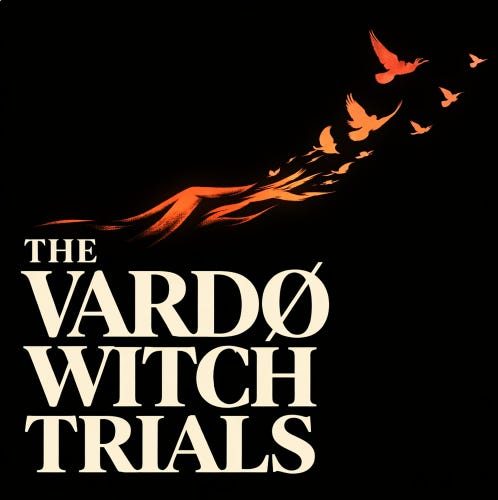
One of my most basic bitch qualities is that I am pretty into reading / consuming content about the Salem Witch Trials. (When I was in publishing, I worked on Stephanie Schiff’s The Witches.) The idea of burning women at the stake for nothing is not new to me. So maybe it’s just because of my age, or maybe it’s because of everything happening in the news right now, but The Vardø Witch Trials hit me so differently and made me understand misogyny in a new way. Or maybe it’s just because The Vardø Witch Trials is so good. You know about Salem. But have you heard about Vardø, a place above the Arctic Circle where 91 people, mostly women, were put to death between the early 1600s and 1692? It’s OK. Hardly anyone outside of Norway has, either. (BTW for comparison, 25 people died during the Salem witch trials.) The Vardø Witch Trials is a beautiful documentary from Lisa Williams, who takes us straight to this breathtakingly cold town. We can hear the brutal sharp wind. (“the weather feels like it’s dark magic from the devil.”) There are no people but tons of birds, which doesn’t technically make the place scarier but it doesn’t help. The sound design here is striking. It makes the Arctic itself feel like a character in this story. Anyway, that is where Lisa plops us at the beginning of this show, where the accused lived and were imprisoned. Lisa gets rare access to the original court records, with historian Professor Liv Helene Willumsen reading the women’s words aloud from the 17th-century books. We hear the confessions. In one, a woman walks into the sea and becomes a whale while her daughter follows as a seal. An eight-year-old girl says she flew as a crow to a lit window and looked in at people wearing white shirts. It’s hard to imagine confessing to these things if you were innocent, which these women were, but I guess that speaks to the power of the courts and leading questions from aggressive, angry men. We learn about a famous witch-hunting manual and seventeenth-century demonologists, mostly celibate clerics, who had a whole theory about why women were supposedly more susceptible to the Devil—weak faith, weak wills, gossip, secrecy, sexual appetites, an inability to be understood by men. But really, it all goes back to good old universal / timeless misogyny and the fear that women can and will undo men. Nothing is scarier to men in power. Then and now, women are guilty until proven innocent. The Vardø Witch Trials tells an important and timely untold story that’s giving something to these women, 400 years later, that the courts never did—the benefit of the doubt. It’s also atmospheric and deeply researched and just plain spooky. Do not miss episode three, where Lisa is literally going through the court records only to be interrupted by unexplainable banging noises throughout. Lisa, what was that? Hold me. ~sponsored~
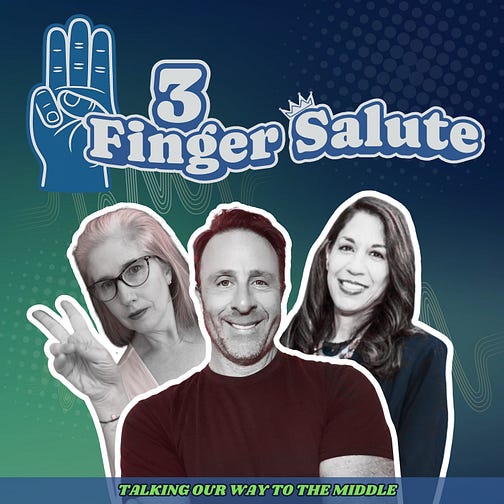
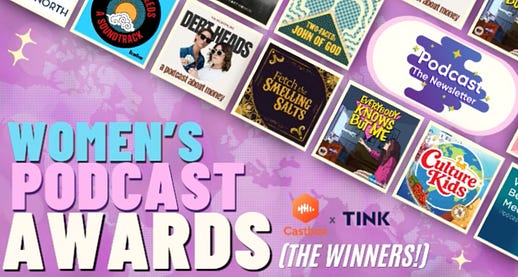
What happens when three TV journalists who’ve seen it all, but don’t see eye-to-eye, team up to pose the questions you’ve always wanted to ask? Join Natasha (the Connector), Mike (the Cynic), and Kristin (the Wildcard) on 3 Finger Salute, as we invite new and old friends to sit down and share their stories. From OnlyFans to Psychics to Those Who Tip Well (and Those Who Don’t) and Polyamory Devotees -- our conversations are unfiltered, unexpected, and unapologetic. We often disagree, occasionally agree to disagree, but we never disrespect. notes📌Yesterday, Arielle Nissenblatt🎧 featured podcasts about boobs in EarBuds. 📌Sure, you might be a bit exhausted by traveling all over the place for billions of podcast events this fall, but you will be rarin’ to go again in February for On Air Fest, one of my favorite audio thingeys of the year. Get tickets here. 📌I’m still reeling from the IWPAs! Castbox is highlighting the winners in a beautiful carousel!
💎podcasts i texted to friends💎
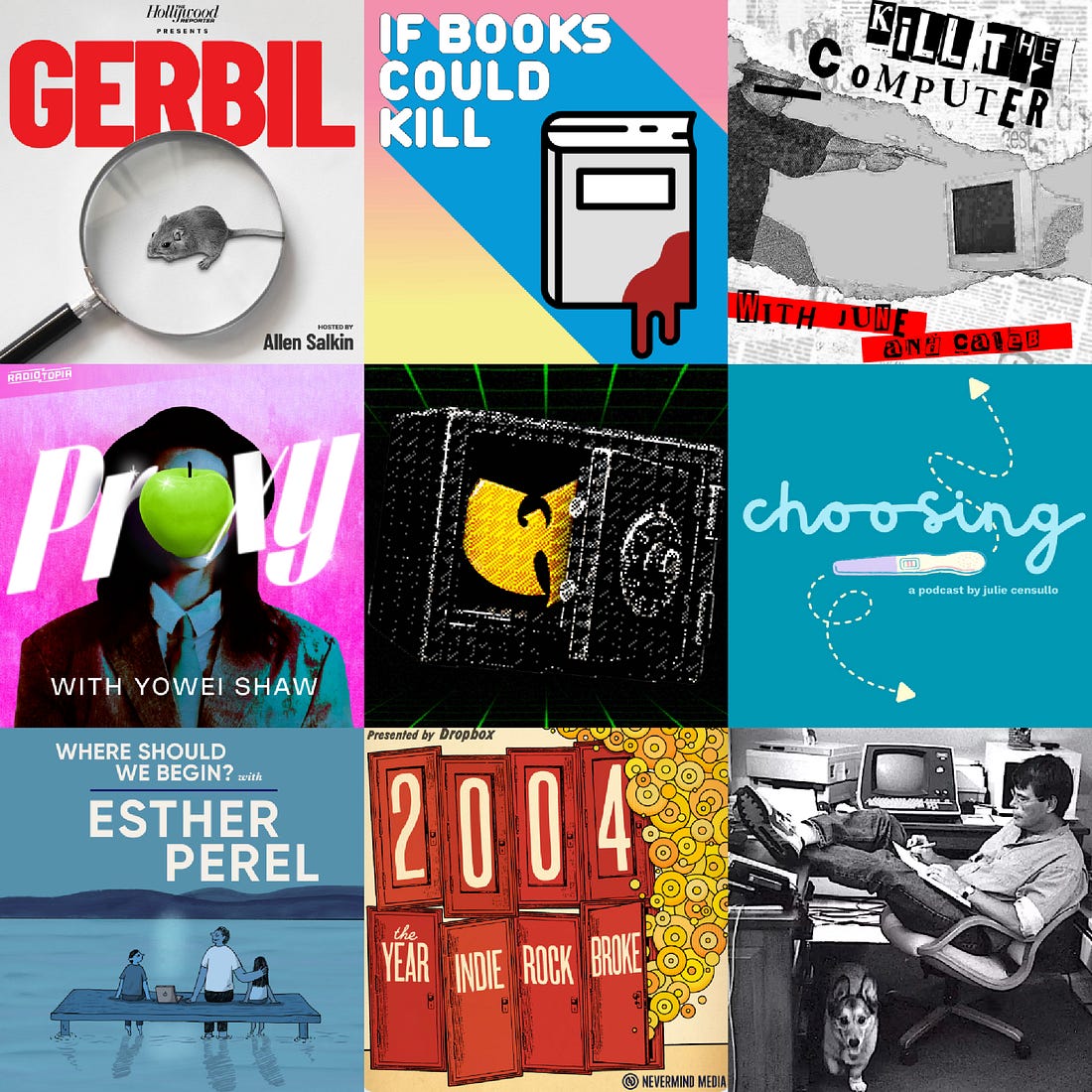
✨The second I started listening to Choosing, I immediately felt this jolt of energy. It felt different. My ears were perked. Julie Censullo is making a show about the way people choose to or not choose to become parents. So it’s not about parenting or parenthood. It’s about the interesting paths people take to get there. It’s like she’s hand sewing the stories and serving them to us with care. She interviews people with intentional conversations and weaves in narrative and audio artistry that is admirable and makes it so fun to listen to. I blew through the episodes on IVF, adoption, and more. There is an incredible interview with Britta Green, of one of my favorite shows, Phonograph, about how Britta made the difficult decision to undergo a selective reduction procedure when she found out she was pregnant with triplets. You should check out this show if those episodes interest you, or even if not. This show is so thoughtfully made, I think I would listen to it no matter what Julie had decided to point her lens toward. I actually had a moment where I was like “wait who the fuck is this person?!?!” and I looked her up and realized she has made many beautiful things, like Out Cold, which I loved. I’m so glad Julie is using her skills to tell a different kind of story. Listen to Choosing here. How I discovered it: Email Julie ✨The last few regular issues of Podcast the Newsletter have been heavy, sad and dark. So I felt relieved when I saw Gerbil featured in Apple Podcasts. It was just what I needed. Allen Salkin has done a serious investigation into something seemingly non-serious—the unproven rumor that Richard Gere was hospitalized after inserting a gerbil into his rectum. Allen, (a real-ass investigative journalist) spent six years looking into where the rumor started (he is able to pinpoint a patient zero, a handsome, famous news anchor in Philly,) why it stuck (homophobia!) and what it tells us about celebrity, media, and gossip. This is a Hollywood Reporter podcast, after all. You also get a solid 101 on gerbiling, which seems crucial in understanding why THIS why THEN why RICHARD (homophobia! Homophobia! homophobia!) This podcast gets past the weirdness and salaciousness part of the story to understand the psychological forces that drove these rumors and movements in general to find something more interesting…why we believe the things we believe. If our beliefs hurt people, are we able to stop them? Listen to Gerbil here. How I discovered it: Featured in Apple Podcasts ✨Michael and Peter’s episode of If Books Could Kill about Sherry Argov’s 2002 book Why Men Love Bitches was hilarious for so many reasons. It’s just funny to hear two guys pretty out of their element. They are emotionally intelligent people who believe that women are smart, capable, and worthy of everything men have. So it’s funny to hear them read from the book that uses the phrases “bitch on wheels” and “hoochie gear.” But really, the funniest part is envisioning the world that this world exists in. One “man” (surely fake) brings “Samantha” to a boxing match on a first date, where an “overcompensating stripper” is showing off the score cards. (This sets up some great advice about not acting insecure around scantily clad women.) A woman is giving framed photos of herself on a first date. (Do NOT.) Peter and Michael noticed that the book has seen a new popularity on Tiktok, something likely due to the fact that nobody has read it. The message seems to be: be mysterious and mean to men, but also be kind to their fragile egos and penises, which you should not call “little skippy.” The book also seems to be a guide to terrible sex, advising women to communicate nothing. Don’t be a bitch and lead a man on by taking off your top! That’s cruel! (“Everyone wants to be a bitch until it’s time to be a bitch.” —Peter) The author of this book, we learn, is a bit mysterious herself. There is zero biography in the book, zero personal examples. There is no about section on her website and her LinkedIn looks pretty fake. (“This is pretty bitchy of her, I like it.” —Peter) Whoever she is, she seems to have written one big cover up of her own oddly specific insecurities. Sherry must have learned the hard way not to “look up at a guy cross eyed and ask dumb questions like how much longer” during oral sex. How thoughtful of her to pass her sage wisdom onto us. Listen to “Why Men Love Bitches” here. How I discovered it: Subscriber. ✨I’ve always thought that Stephen King was wildly imaginative and creative and brilliant and a punchy writer but I never was a huge fan of his books. I almost never think movie adaptations are better than their book origins, but Kubrick’s The Shining is 40 times better than King’s. It is an film adaptation that King famously hated. Eric Molinsky had an episode of Imaginary Worlds that changed the way I think about King, and helps explain why I appreciate so much about King but not always his books. It’s because Stephen King is not a horror writer. Eric invited Caroline Bicks (Monsters in the Archives: My Year of Fear with Stephen King), Neil McRobert of the podcast Talking Scared and Kim C. of the podcast The Year of Underrated Stephen King to talk about what his books are really about, and how his skills come together perfectly to achieve what he’s trying to do every time. Instead of a horror writer, you could consider Stephen King a chronicler of American life. He’s using horror to expose what’s already frightening about it. His monsters may be supernatural, but his settings are familiar small towns and all that happen inside of them…petty hierarchies, local legends, class resentments, family secrets, religious fervor, school bullies, and simmering violence. Settings are diners, high schools, town meetings, summer jobs…and he makes them uncanny, which forces us to look at what we are nostalgic for straight in the face, and it is horrifying. In this reading, his books are like sociological portraits of rural America. I am screaming right now. And about to reread all the Stephen King I’ve ever read back when I was a dumb dummy who thought Stephen King was a horror writer. Listen to “Stephen King and the Horror of the Ordinary” here. How I discovered it: Subscriber. ✨Proxy is a great show and every so often there is an episode that seems to offer the kind of listening-in-on experience that is maybe never-before-heard and totally unique. (I am thinking “Bisexual Wife Guy” and “Alex’s Husband Is Too Straight.”) The episode “Ellie and the Other Woman” was prompted by an email from Ellie, a woman who “never thought she’d be the other woman. Then she fell in love with a married man.” You might be raging already. In this divided nation, most of us can agree on one thing: if you have agreed that cheating is not OK and you cheat, you are bad. This opinion can usually be emotionally backed by your own personal pain, whether that be yours or someone close to you. If my friend has been cheated on, I don’t need details, I HATE the other two (or more) people in question. It would seem natural for Yowei to set Ellie up with someone who has been cheated on, but that is not what she decides to do. She sets her up with a woman who has also been the other woman. This technically doesn’t make sense, but in practice, it does. Ellie doesn’t need to know the other perspective. In this case, she already feels bad. She needs to know what to do about it. What has someone else done about it? Here, the proxy and Ellie have a lot in common, and the result is one of those interesting tangles of opinions and feelings. I mean, the first thing that I thought was, “you never thought you’d be the other woman? What does that mean? That you think you’re better and that other people are worse?” I still am not sure why people can’t just be honest with their partners, and themselves, before they fuck someone else. But it was cool to kind of observe them behind one-way glass in this way. Ellie and the proxy were shocked that they have so much in common, but I’m not sure that’s a coincidence. These women are not as unique as they think they are. So while we get to hear all about their relationships, universal truths do surface. One of them being that it’s arguably harder to be the cheater outside of the relationship than the one in it. If you are in it, you can work on your relationship with the person you cheated on. You can make things better. If you are “the other woman” and have guilt about that, it’s all you. You can resolve a conflict with another person, but you might never resolve a conflict with yourself. This episode was letting us know exactly what it is like to be the other woman and it did an interesting thing to my brain. The rational side of it kept on having lots of empathy and live-and-let-live vibes, the emotional side of it was pissed. Imagine the person who have wronged you in this way saying these words. Depending on how fresh the wounds are, it’s not going to help. Listen to “Ellie and the Other Woman” here. How I discovered it: Subscriber. ✨It felt so good, and it was so much fun, to hear Caleb and June of Kill the Computer and Josh and Brian of The Worst of All Possible Worlds completely rip apart MrBeast's “LLM-ridden slopfest” The Most Dangerous Games, “co-written” by James Patterson. (It’s a dystopian thriller in which 1,000 people from around the world are invited to compete in a brutal contest. MrBeast is offering people a chance to win $1M by reading it and solving puzzles hidden inside it.) My algorithm doesn’t expose me to MrBeast stuff, so I love hearing smart people talk about his empire. How can you not be fascinated in all that he is doing to attract all the attention he has? I also just love publishing stories. (When I worked in publishing, James Patterson was actually one of my authors.) So while this shit show sits securely in my wheelhouse, watching something awful fail with glee is universal, so it’s fun for all to hear how The Most Dangerous Games is tanking, relatively speaking. (Yes it made $800K in the first week but was won in a bidding war for at least $10M.) People in power frequently operate hideously without consequence, so hearing about the book’s flop is cathartic. We need an occasional reminder that goodness can prevail. And this was a really amusing way to do it. Caleb, June, Josh and Brian read the book, or tried to. One of them is actually trying to win but reports that the writing is so bad that it’s actually hard to understand what is happening, even if you are following along. This game sounds too frustrating to be considered fun. But we don’t have to play along or even read along. We just get to listen. Hear “The Most Dangerous Games” here. How I discovered it: Subscriber. ✨This pity might be misdirected, but I feel particularly bad for musicians who have been trying to make it over the past 20 years. Media has changed everywhere but, like, you can still buy books in bookstores and you can still see a movie at the AMC. The way we buy and consume music has changed the most drastically. It wasn’t that long ago I had to go to a physical store to buy a CD, I haven’t owned a CD player since like 2004. I initially wrote that number unironically but it happens to be, according to a new podcast called 2004: The Year Indie Rock Broke, a really important year in music history. 2004 was about the time that MTV started abandoning music videos, commercial radio was stuck in its rotation, and the internet was not yet the bottomless music-discovery machine it is today. TV shows like The OC and movies like Garden State were HUGE. And that is how they became unlikely tastemakers, introducing us to bands we weren’t discovering in the old ways we were used to. 2004: The Year Indie Rock Broke, hosted by Best Coast’s Bethany Cosentino, revisits the moment Death Cab for Cutie, The Shins, Arcade Fire, et. al went from playing in tiny venues in small towns to making it big. She’s talking to artists and industry figures who went through it. This is a look at how soundtracks, early internet culture, and the eternal indie-rock anxiety over selling out reshaped the way we were finding music, back when hearing a song in a teen drama could change your life, or at least your AIM away message. Listen to 2004: The Year Indie Rock Broke here. How I discovered it: Email from Courtney E. Smith. ✨The story about Wu Tang Clan’s secret album Once Upon a Time in Shaolin is already good. There is only ONE copy that you may remember was bought by scumbag Martin Shkreli in 2015 for $2M, WHAT A LOSER. The Wu-Tang Clan recorded their parts of the album separately, it was produced by Silver Rings, and Method Man had never even heard it. And technically, nobody should be allowed to hear it until 2013. It was made with an 88-year ban on commercial release. After Martin Shkreli’s securities-fraud conviction, the government seized it and it eventually landed with PleasrDAO, a crypto-art collective. Anyway, Pablo Torre set up a listening party (at this bar called Eavesdrop in Brooklyn,) invited Method Man, and released some of the audio on Pablo Torre Finds Out, so we get to hear not only Method Man’s reaction (“I do not hate this album”) but part of the album. Pablo Torre is not lying when he’s saying he’s finding stuff out. He’s built an actual reporting operation with a team of producers, a tip line, he relies on exclusive documents, sources and resources to pursue stories rather than just discuss them, going beyond which most podcasts are able to do. (Remember that week Pablo was busy releasing exclusive security footage of Kelly Clarkson in Art of Play. Listen to “Unboxing Wu-Tang’s Secret “Once Upon a Time in Shaolin” Album for Method Man — and You” here. How I discovered it: Subscriber. ✨Earlier this year, Where Should We Begin?’s Esther Perel mentioned that each decade, she has a couple walk into her office and she thinks: “this is a threshold moment.” (The first time she sat with a couple getting divorced when no-fault divorce went mainstream, a couple discussing IVF and egg donors, a poly couple, a couple exploring surrogacy…) AI intimacy is the latest. (I wrote about her interview with a man in love with his AI assistant. She handled that conversation so beautifully.) I also loved “My Ex, His AI Girlfriend, And Our Kids,” where she talks to a woman whose ex-husband (who ended the marriage, BTW) is now in love with an AI bot, and what that means for their children. It’s messy in all sorts of ways (think about how confused you’d be if this was your dad) but this AI bot is not going away. Esther drills down on the difference between an AI problem and a regular divorce one, an important and interesting distinction. But still, literally where do we begin when we start to wonder what to tackle first? Esther approaches with kindness and gentleness but also a bluntness that doesn’t ignore this woman’s reality. At one point the woman worries about normalizing something that she doesn’t think is normal for her kids, and I thought, ‘a-ha! That is a great place to start.’ But Esther says it’s not normalizing, that it’s talking about something that is there. This gets into a discussion about how generational cycles get broken, and have always been broken, by talking about them. It’s timeless, and even applies to something new like AI intimacy. I loved it when the woman says, toward the end, “that was beautiful, I wish I was writing this down,” and Esther replied, “well we are recording this.” Listen to “My Ex, His AI Girlfriend, And Our Kids” here. How I discovered it: Subscriber. ✨ I love you! You're currently a free subscriber to Podcast The Newsletter. For the full experience, upgrade your subscription.
|