🔮 Safety in numbnessOn originality, intellectual bravery and why disagreeing with LLMs is a good sign
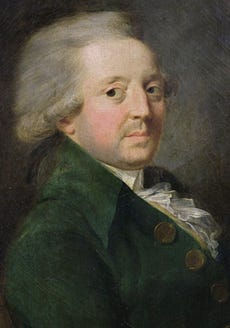
Standardization matters. The Marquis de Condorcet, the French Enlightenment thinker I’ve studied extensively over the past year, understood this in 1794. He was interested in the shared notations and symbolic languages—standardization—through which knowledge could accumulate:
Standardization was meant to propel fields forward. It was a ladder to scramble onto the shoulders of the giants, then push beyond. Beyond meant different. Sometimes it’s a matter of magnitude, of going further in the same direction. Sometimes it’s less about direction than about adding new dimensions, ideally orthogonal, to explore. Or revisiting well-trodden ground with new sensibilities. But most importantly, it meant new. Reading Erik Hoel’s excellent essay, “How the MFA Swallowed Literature,” reminded me of what happens when standardization does the opposite. Instead of raising everyone up so they can see further, standardization can comfort us to flatten the world. Erik describes literary fiction being deracinated by a protocol that became ubiquitous. I think it foreshadows what LLMs might catalyse in other fields, both near and far. Erik argues that the rise of MFA in Creative Writing programmes has steamrolled literary fiction. The key is that these programmes have a standard formula: group workshop after group workshop, critiquing each other’s drafts. Rinse and repeat. It’s a protocol: take aspiring writers and, through repeated peer review, sand away peculiarity, weird ambition and the unfamiliar edges most likely to attract an objection. Out the other end comes writing that’s homogenized and optimized to survive the workshop: “wan little husks of ‘auto fiction’”, as Joyce Carol Oates put it. An entire economy has grown around a defensive style of writing that minimizes the novel’s “attack surface.” There were 15 MFA programs in the US in 1975 and 250 by 2012. Today, Erik argues the craft of literature and the program supposed to teach it have become identical. “One ate, digested, absorbed the other”. The point of a literary culture is to find authors who help us rethink the canon. I think of Salman Rushdie’s Midnight’s Children, and the unruly memory that carries the myths, languages, and history of an independent India. He expanded the canon, changed what an English novel could be. He also gave new writers taller shoulders to stand on. Rushdie’s innovation was first a style, then a category, then a set of conventions. And finally it became mundane. Now we need to find the next writer who changes the form. Homogenization, which I think of as safety institutionalized, makes this harder.
It’s a problem of systems meeting incentives. In literature, the system is how creative writing gets taught and how that slowly makes each writer’s pages remind you of the others. And downstream, the publishing machine molds to the shape of that output. But it’s not a process limited to fiction. A key purpose of any creative domain, be it scientific or artistic, is to find the next, not to repeat the last, with a tiny increment. Some systems foster modest speciation; others, a Cambrian explosion. The wrong system paired with short-term incentives will encourage the former. And this is where the LLM comes in. An LLM is a standardised system, trained against particular incentives, to output against a particular statistical distribution with its very own shape. We’ve all experienced it. Subscribe to Exponential View to unlock the rest.Become a paying subscriber of Exponential View to get access to this post and other subscriber-only content. A subscription gets you:
|